Most AI projects end in a slide deck. Ours ends in your P&L.
We work with banks, lenders, insurers, and law firms that bought AI and aren't seeing a return. We start with your executives building with it themselves, then do the same for the teams who run the work, all the way to changing how you run the business.
Two years ago no leader knew where to start. Today every leader thinks they've started.
88%
of companies use AI in at least one function.
6%
are turning it into real productivity and leverage.
The software isn't the problem. Only 21% of companies using AI have actually redesigned how any piece of work gets done, and that redesign is what separates the ones getting leverage from the ones getting activity. Everyone else bought the licences, ran the training, opened a channel called #ai-wins, and watched the usage numbers climb while the work itself stayed exactly the same.
Usage is up and to the right. Productivity is flat.
Why we work the way we do
Adoption doesn't start in the org chart. It starts at the top.
If the executive team has never built anything with AI, they can't tell a real opportunity from a demo, and their people can see that. So we start with the leadership team, then work down a layer, then the layer after that. Each group gets hands on the tools, gets a way of thinking about it, and gets the fear taken out of it before they're asked to change how they work.
If your staff are being told to use AI but your leaders aren't, you don't have an AI strategy. You have a memo.
Layer 1
Your executive team
They get hands-on experience, using AI as a thinking partner rather than a basic tool, and start practising.
→
Layer 2
The leaders who run the functions
Underwriting, operations, claims, sales. The people whose processes actually have to change.
→
Layer 3
The teams doing the work
Building on their own workflows, with their own data, in an environment your IT team has cleared.
We create the aha moment
People change when they feel something work in their own hands, not when they are shown a slide about it.
We give them a way to think about it
A simple, repeatable method for briefing AI and judging what comes back.
We take the fear out
Most quiet resistance is people worrying they will look slow, or be replaced. We name it in the open and deal with it.
We manage the change
Fear is the top barrier holding people back. We manage the change with hands-on exercises that show the value, not slides about it.
We clear risk, legal, privacy and security
We work within your industry context and your language, with deep experience in regulated industries, alongside your own partners in risk, IT, and legal.
We stay until it holds
We train one person inside each team to keep it running. If we leave and it stops, we did not finish.
What that looks like in practice.
01
AI Executive Lab
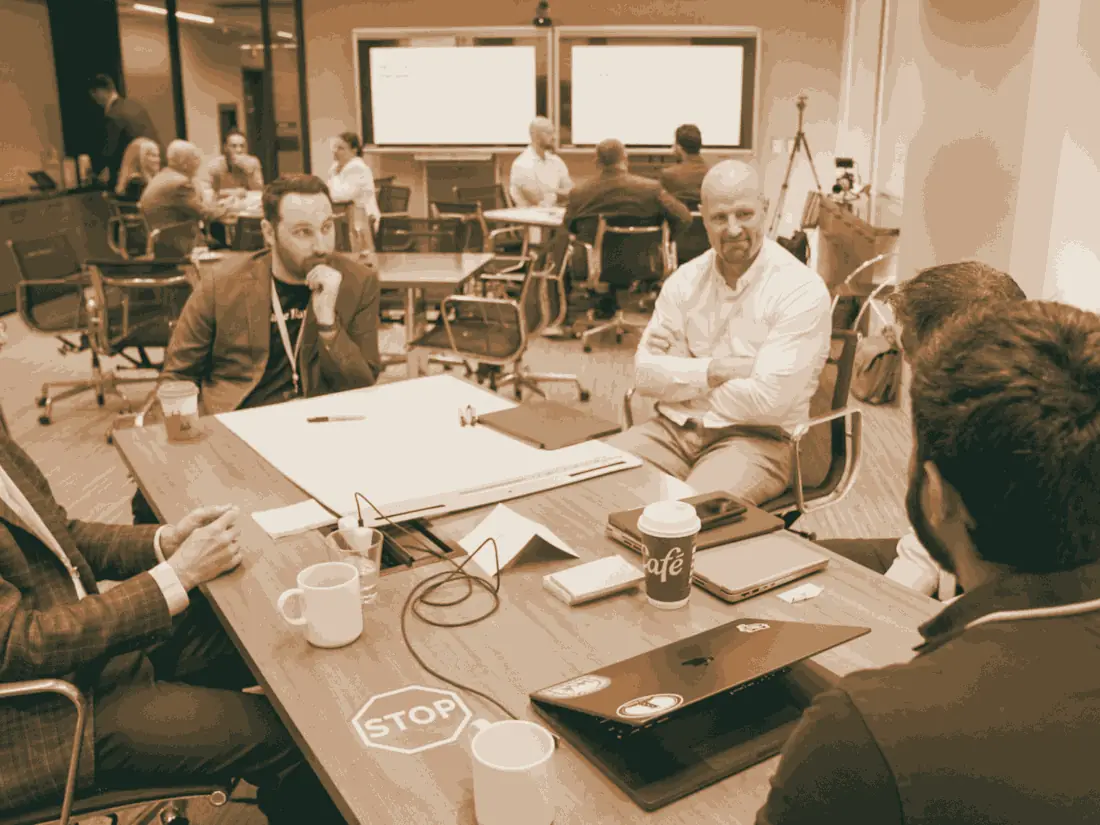
A full day. Each of your executives builds a working AI tool for a real problem in their own job, with a coach at every table. The goal isn't a demo, it's the aha moment: the confidence that comes from leading AI, not just approving it. You can't learn a language by reading the textbook, and you can't lead AI by reading about it either. When the group is too large to build, we run the talk instead.
Full dayTen to twenty executives, three or four per table, a coach on every table.
02
Enable the teams who do the work
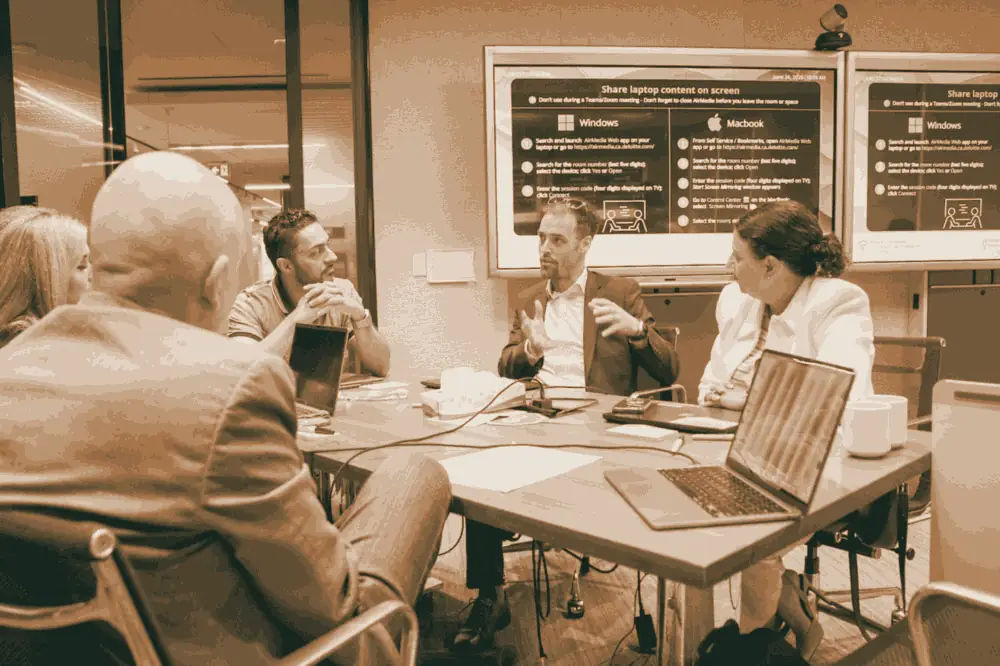
The same full day, run for one department at a time. Underwriting, then operations, then sales enablement. Each session gets the department confident, gives them the inspiration to drive the change themselves, and names the champions, the citizen developers, who carry it forward. Every session finishes with three things: a tool that works, one named person who owns it, and the number it is supposed to move.
Full day, one department at a timeTwelve to sixteen people, their own work, their own data.
03
From napkin to production, measured in ROI
We lead it: from a napkin sketch, to a live build in production, to a number you can measure, tied back to real ROI. We decide which department goes next, get builds approved by legal, risk and IT, report on the numbers every month, and train one person inside each team to keep it running once we step back. When something needs real engineering, we bring in a development partner and manage them.
For as long as the change takesMonthly cadence, reporting to your executive team.
AI that moves the needle on your business
Every business is judged on a few numbers it has tracked for years. Days to close a file. Touches per application. Cost per unit.
We pick one with you before anything gets built, write down what it reads today, and agree what it should read in ninety days. You check it yourself.
If we can't find a number that will move, we say so and pass.
Days to close a file12→4
Touches per application9→2
Hours to clear an exception6→1
Illustrative. Yours gets set with you, in your own numbers.
Takes 30 seconds · nothing to fill in
See where you stand
Four questions to ask about the AI you've already paid for.
Pick one place you've put AI to work. Tick every statement below that is true of it today.
01
Somebody's job description actually changed.
If nobody's role was rewritten, you added a tool to the old way of working. That is not the same as changing it.
02
We redesigned the process, rather than bolting AI onto it.
Asking "where can AI help with what we already do" gets you a slightly faster version of the process you already had.
03
We budgeted for retraining people, not just for licences.
McKinsey's rule of thumb is about three dollars of change management for every dollar spent on the technology. Most budgets are the other way round.
04
A number we have tracked for years is dropping.
Days to close a file. Touches per application. Cost per unit. If none of them moved, nothing real changed.
0 of 4 true
Tick the boxes above.
Most leadership teams find they can only tick one of the four, and the one they miss is almost always the last.
You think your people are on board with AI. Ask them.
76% of executives believe their employees are enthusiastic about AI. Only 31% of employees say they are. That 45-point difference is why so many rollouts quietly stall.
It asks you five things, then asks your team the same five things. Was AI introduced as an order or an invitation. Can people admit they don't know something. Do they learn where others can see. Do they think it is meant to help them or replace them. And are you counting logins or results.
Biggest gap: can people admit what they don't know. You scored it 78. Your team scored it 41. Only one of those numbers is true.
What you saidWhat your team said
1
Spend five minutes answering questions
On your own, about how AI actually landed in your organisation. Nothing to prepare.
2
Invite your team to get their take
You send a link, they answer the same questions from their own seat. Ninety seconds each. Their individual answers are never shown to you.
3
You get the report
Both sets of answers side by side, your widest gap, how you compare to other organisations of your size, and one thing that will move the needle in the next thirty days.
Individual answers stay confidential. You only ever see the aggregate, and only once at least three people have replied.
Insights
The thinking behind the work.
Published for around 10,000 readers. These are the three executives forward most.
There is no shortage of people willing to advise you on AI. There are very few who have run the change inside a regulated business, been in front of the risk committee, and had to answer for the number afterwards. That is the work we do.
We only work in regulated industries
Lending, banking, insurance and legal. The constraints are the whole problem, and we know which doors a build has to get through before it ships.
We have built the businesses, not just advised them
Companies founded and run, one acquired, plus fifteen years of enterprise transformation inside Fortune 500 accounts. Both halves matter.
People, process and technology, together
Most firms hand you one of the three and leave you the joins. The joins are where AI programmes come apart, so we take the whole thing.
Training ends with a good feeling. We end with a named owner and a number that moved. The fluency work happens on your real build, never as standalone training.
How long does an engagement take?
A Lab is one day. A traction engagement runs up to 90 days on one workflow. A fractional seat runs for as long as the change takes, on a monthly cadence.
Do you build inside our environment?
Yes. Teams build on their own workflows and their own data, in an environment your IT team has cleared, not a sandbox.
What if the workflow you look at won't actually move a number?
We say so and pass. No collapse, no engagement is a hard line, not a sales line.
Who do you work with?
Leadership teams at regulated companies: banks, lenders, insurers, and law firms.
Start here
Two ways to begin.
Find out where you actually stand. Free.
Five minutes of your time, ninety seconds each from three of your people. You get both sets of answers side by side, the widest gap between them, and one thing that will move the needle in the next thirty days.
Sources. Adoption and earnings gap: McKinsey, State of AI, November 2025. Workflow redesign and the change-management ratio: McKinsey, 2025. Leader and employee perception gap: Harvard Business Review, BCG and Columbia Business School, 2025. June 2026 AI Lending Lab figures are first-party, n=13.